
Choose the correct sketch of the magnetic field lines for a pair of parallel current-carrying wires,one with current flowing into the plane (represented by $\otimes$) and one with current flowing out of the plane (represented by $\odot$).
- A
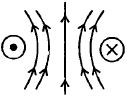
- B
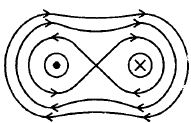
- C
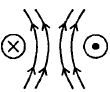
- D
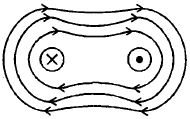
Explore More
Similar Questions
In a thin rectangular metallic strip, a constant current $I$ flows along the positive $x$-direction, as shown in the figure. The length, width, and thickness of the strip are $\ell$, $w$, and $d$, respectively. A uniform magnetic field $\vec{B}$ is applied on the strip along the positive $y$-direction. Due to this, the charge carriers experience a net deflection along the $z$-direction. This results in the accumulation of charge carriers on the surface $PQRS$ and the appearance of equal and opposite charges on the face opposite to $PQRS$. A potential difference along the $z$-direction is thus developed. Charge accumulation continues until the magnetic force is balanced by the electric force. The current is assumed to be uniformly distributed on the cross-section of the strip and carried by electrons.
$1.$ Consider two different metallic strips ($1$ and $2$) of the same material. Their lengths are the same, widths are $w_1$ and $w_2$, and thicknesses are $d_1$ and $d_2$, respectively. Two points $K$ and $M$ are symmetrically located on the opposite faces parallel to the $x$-$y$ plane (see figure). $V_1$ and $V_2$ are the potential differences between $K$ and $M$ in strips $1$ and $2$, respectively. Then, for a given current $I$ flowing through them in a given magnetic field strength $B$, the correct statement$(s)$ is(are):
$(A)$ If $w_1=w_2$ and $d_1=2d_2$, then $V_2=2V_1$
$(B)$ If $w_1=w_2$ and $d_1=2d_2$, then $V_2=V_1$
$(C)$ If $w_1=2w_2$ and $d_1=d_2$, then $V_2=2V_1$
$(D)$ If $w_1=2w_2$ and $d_1=d_2$, then $V_2=V_1$
$2.$ Consider two different metallic strips ($1$ and $2$) of same dimensions (lengths $\ell$, width $w$, and thickness $d$) with carrier densities $n_1$ and $n_2$, respectively. Strip $1$ is placed in magnetic field $B_1$ and strip $2$ is placed in magnetic field $B_2$, both along positive $y$-directions. Then $V_1$ and $V_2$ are the potential differences developed between $K$ and $M$ in strips $1$ and $2$, respectively. Assuming that the current $I$ is the same for both the strips, the correct option$(s)$ is(are):
$(A)$ If $B_1=B_2$ and $n_1=2n_2$, then $V_2=2V_1$
$(B)$ If $B_1=B_2$ and $n_1=2n_2$, then $V_2=V_1$
$(C)$ If $B_1=2B_2$ and $n_1=n_2$, then $V_2=0.5V_1$
$(D)$ If $B_1=2B_2$ and $n_1=n_2$, then $V_2=V_1$
Give the answer for question $1$ and $2$.
$1.$ Consider two different metallic strips ($1$ and $2$) of the same material. Their lengths are the same, widths are $w_1$ and $w_2$, and thicknesses are $d_1$ and $d_2$, respectively. Two points $K$ and $M$ are symmetrically located on the opposite faces parallel to the $x$-$y$ plane (see figure). $V_1$ and $V_2$ are the potential differences between $K$ and $M$ in strips $1$ and $2$, respectively. Then, for a given current $I$ flowing through them in a given magnetic field strength $B$, the correct statement$(s)$ is(are):
$(A)$ If $w_1=w_2$ and $d_1=2d_2$, then $V_2=2V_1$
$(B)$ If $w_1=w_2$ and $d_1=2d_2$, then $V_2=V_1$
$(C)$ If $w_1=2w_2$ and $d_1=d_2$, then $V_2=2V_1$
$(D)$ If $w_1=2w_2$ and $d_1=d_2$, then $V_2=V_1$
$2.$ Consider two different metallic strips ($1$ and $2$) of same dimensions (lengths $\ell$, width $w$, and thickness $d$) with carrier densities $n_1$ and $n_2$, respectively. Strip $1$ is placed in magnetic field $B_1$ and strip $2$ is placed in magnetic field $B_2$, both along positive $y$-directions. Then $V_1$ and $V_2$ are the potential differences developed between $K$ and $M$ in strips $1$ and $2$, respectively. Assuming that the current $I$ is the same for both the strips, the correct option$(s)$ is(are):
$(A)$ If $B_1=B_2$ and $n_1=2n_2$, then $V_2=2V_1$
$(B)$ If $B_1=B_2$ and $n_1=2n_2$, then $V_2=V_1$
$(C)$ If $B_1=2B_2$ and $n_1=n_2$, then $V_2=0.5V_1$
$(D)$ If $B_1=2B_2$ and $n_1=n_2$, then $V_2=V_1$
Give the answer for question $1$ and $2$.
$A$ proton beam is moving from north to south and an electron beam is moving from south to north. Neglecting the Earth's magnetic field,the electron beam will be deflected (assuming zero gravity):
Easy
View Solution$A$ proton moving with a constant velocity passes through a region of space without any change in its velocity. If $\vec{E}$ and $\vec{B}$ represent the electric and magnetic fields respectively,then the region of space may have :
$(A)$ $E=0, B=0$
$(B)$ $E=0, B \neq 0$
$(C)$ $E \neq 0, B=0$
$(D)$ $E \neq 0, B \neq 0$
Choose the most appropriate answer from the options given below :
$(A)$ $E=0, B=0$
$(B)$ $E=0, B \neq 0$
$(C)$ $E \neq 0, B=0$
$(D)$ $E \neq 0, B \neq 0$
Choose the most appropriate answer from the options given below :
DifficultJEE MAIN 2024
View Solution$A$ beam of electrons and protons move parallel to each other in the same direction. Then they:
Easy
View SolutionTwo protons move parallel to each other,keeping a distance $r$ between them,both moving with the same velocity $\vec{v}$. Then the ratio of the electric force to the magnetic force of interaction between them is:
Vedclass Products
For Students
Vedclass Test Series
Mock tests in real JEE/NEET style with performance analysis. 5-day free trial.
Start Free TrialFor Teachers
Exam Paper Generator
Generate Set A/B/C/D exam papers from 7.5L+ questions in 2 minutes. 3 chapters free.
Try FreeFor Institutes
Online Exam Module
Live online exams with unlimited students, 360° analytics & white-label branding.
See Demo